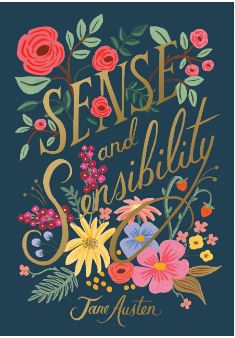
"Sense and Sensibility"
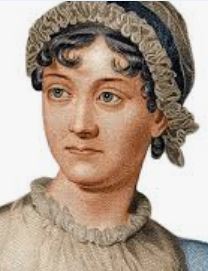
by Jane Austen.
Sense and Sensibility is Jane Austen's first book to be published in, 1811, when she was 35, though she had begun writing it in letter form in 1795.
It was published as written by A Lady, not in her name.
A sign of the times! Initially it was to be called Elinor and Marianne and these two are the main characters- Elinor-sense and Marianne -sensibility.
The story is about love, heartache, social conduct, social etiquette of the time (among a certain class, there is little mention of working class people), secrets and lies,
a social commentary of the patriarchal society- inheritance ,wills, money, wealth- and the role of women and their status in society.
The story revolves around the Dashwood family. Mrs Dashwood, recently widowed, and her 3 daughters - Elinor,19yrs, Marianne,16 yrs and Margaret 13yrs., have to leave their home Norland Park in Sussex, following the death of her husband.
The house and estate were left to Mr Dashwood's son by his first wife and little provision was made for Mrs Dashwood and the girls,
not helped by the attitude of the son who did not feel obliged to help and does not follow the wishes of his father's will.
Though they remained in the house for several months after Mr Dashwood's death, while new accommodation was to be found, it was not a comfortable time as the son's wife did not want them there.
They move to a cottage in Devon, offered to them by a second cousin, Mr John Middleton a very affable, hospitable man.
There they are introduced to many new people and life revolves around daily visits from Sir John, country walks along the lanes or up the hills, dining in the evening at Sir John's followed by card games , music etc.
Usually large parties of people which Lady Middleton seemed to tolerate rather than enjoy.
Elinor is level headed, pragmatic, keeps her feelings to herself and is not emotional.
She is attracted to Edward Ferrars an attraction which appears to be mutual but they are guarded about making their feelings known.
However, Lucy Steele, another visitor to Sir John's, informs Elinor that she is engaged to Edward, but it has not yet been made public.
More intrigue.
Marianne ( only 16!), on the other hand, falls in love easily, is very emotional and displays her feelings.
She is seduced by Willoughby and after only knowing him for a week is completely head over heels and believes him also to be so.
Everyone assumes them to be engaged but nothing has been said. Then he leaves suddenly and unexpectedly.
Marianne is upset but believes he will write to her, he does not.
He is a cad, a rotter, a scoundrel! Colonel Brandon, 35 years old, a friend of Sir John Middleton, is deeply attracted to Marianne (today that would throw up concerns!)who does not reciprocate.
Elinor and Marianne then go to London, encouraged by their mother, with Mrs Jennings, their sister-in-law's mother, in January, for the winter 'season'.
More visits, dining , card games, balls, musical entertainment.
Marianne has gone to London only in the hope she will see Willoughby.
When he does not appear she descends into despair.
She eventually learns that he is to married to someone else, for money of course.
More weeping and wailing.
Edward Ferrars does visit the London home of Mrs Jennings and he and Elinor keep a guarded distance.
He is however engaged to Lucy Steele.
I did not find the book easy to read, mainly because of the language- deep concentration needed.
Also sorting out the relationships and connections of the characters involved.
Jane Austen's writing is satirical and she is observant of the social mores of the day.
The role of women (girls really) was to be married asap, preferably to a wealthy man. Money and influence were paramount.
If the woman had money then she would be pursued by a man who had less or she would marry someone of equal wealth.
Daughters lost out to brothers when it came to inheritance.
Will I read another Jane Austen? Not in the near future.
Gail Pearson
November 2025.
The first thing that struck me was how broad an influence she had.
Deeply admired, millions of words have been written about her and her books.
Never having read any Jane Austen, I had thought her a purveyor of somewhat lightweight romance novels.
Having read some biographies and therefore some parts of her books, my thoughts are different but am still not moved to read more.
However, she is an interesting person, ahead of her time in some respects (she rejected the prevailing notion that women were solely for marriage and babies.)
I had to remind myself that she was born in 1775 and grew up in a creative family, supported by her parents in her literary endeavours.
The 2nd youngest of eight children (six of whom were boys) Jane would have experienced the comings and goings of older siblings into the forces-the army and navy- and their participation in war.
(Boys joined the forces at the relatively young age of twelve) Jane’s education began at the age of seven, when she was sent to Cambridge with her sister, Cassandra.
Two years later they were sent to what is now the Abbey School for Girls in Reading.
They would stay there for two years and Jane’s education was completed by the age of eleven.
Although there was little else for a girl of Jane’s social class, she counselled her niece against any thought of marriage if she harboured any doubts about it.
‘Anything is to be preferred or endured rather than marrying without affection.’
This was founded on personal conviction having accepted then declined a proposal of marriage.
(She felt no passion for her suitor!) Life for a girl/woman of Jane’s class was a round of visits to ‘suitable’ families, lunch or a picnic with friends followed by genteel card games.
Seemingly nothing is known about Jane’s romantic inclinations although there are hints and rumours about her affection for a very charming and handsome young man.
Jane’s father died after a sudden illness in 17??. Women relied on their menfolk to provide accommodation and often married to obtain wealth. In
1808 the sisters were given the choice of moving to a smaller house on Edward’s estates in Kent or Hampshire.
They chose Hampshire and moved to Chawton.
Jane began to write in earnest-the Dashwood girls circumstances were features that Jane knew about directly.
Mrs. Dashwood and daughters efforts to create a home through books and personal possessions echoed Jane’s experience.
Her return to Hampshire proved reinvigorating and provided the stimulus for the creative outpouring of the next eight years.
Rosie Palmer
November 2025
|