Group name - Hull Handbell Change Ringers

Plain Minor

The Plain Bob Group

Onwards

  Plain Minor - Crayford Little Bob

Crayford Little Bob Minor

About Crayford Little Bob Minor

Little Bob Minor is simply a Lead End variant of Little Bob. The value in Crayford lies in the learning of a completely different set of Place bells.

Further value is gained from the way that Little Bob Minor changes the hunting pattern at almost every half lead; this encourages good concentration. This aspect of Little Bob extends to the higher stages, and is helpful as an introduction to some of the patterns encountered in ringing Surprise Major Mathods.

Site Sections:

A set of 12 handbells
Home

A set of 12 handbells
Method Ringing

A set of 12 handbells
Leadership

A set of 12 handbells
Methods

A set of 12 handbells
Compositions

A set of 12 handbells
Hull Project

A set of 12 handbells
Appendix

Downloads:

Text Only:

Goals

Goals and learning approach

What you are trying to achieve needs to drive your approach. There is much enjoyment, and a great deal of skills learning involved in Little Bob. Crayford is irritatingly simple in concept but demands good Lead End concentration.

Basic ringing and skills.

Do not memorise the lines, learn the rules, get stuck in, ring, and watch the treble to know when to dodge. It all happens very quickly.

Performance Level

Build on Plain Bob experience, but note how the hunting patterns change. Study the lines.
Practice a lot.

Method Mastery Level

It's better to master Plain Bob and allow those skills to cover Little Bob and then CrayfordLittle Bob.


Structure

Crayford Little Bob Minor is a subset of Plain Bob, but the 4ths place made by the treble introduces an extra pair of dodges in 5-6 and the 1-6 Lead End removes most of the dodges.

Method Structure.

Place Notation:
X 16 X 14, 16, Bob 14, Single 1456.

Grid:

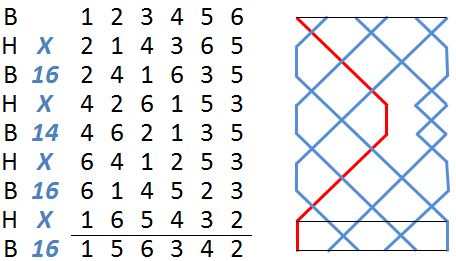
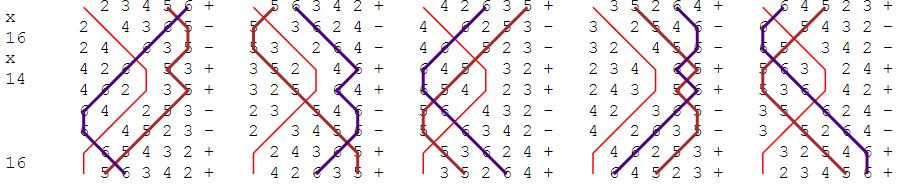
Crayford Little Bob Minor by change rows and a picture

Diagram: Crayford Little Bob Minor, plain lead, change-rows and grid.

Plain Course structure
The Plain Course contains 40 changes which are also found in Plain Bob.


Learning

Learning Crayford Little Bob Minor.

The Structure

Structurally, the method has bite sized chunks of Plain Hunting, and the only dodging is in 5-6 and is caused by the treble turning round in 4ths. But it is best to attempt to ring Crayford Little Bob as a rules extension of Plain Bob.

The Rules

Little Bob: The rules
Ring plain hunting except:
When treble reaches 4ths place, it makes 4ths and the bells in 5-6 dodge.
When treble leads, 6ths place is made and the bells plain hunt.


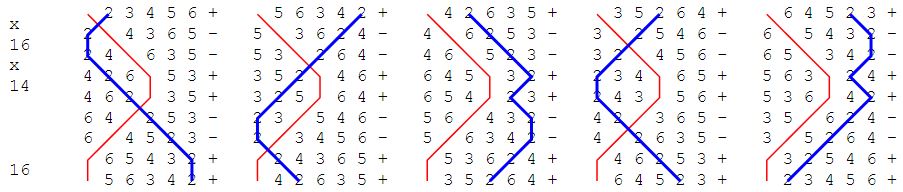
Double Blue Lines
1-2

Double Blue Lines

Crayford Little Bob Minor, 1-2

Crayford Little Bob on 1-2

Diagram: Crayford Little Bob Minor, 1-2.


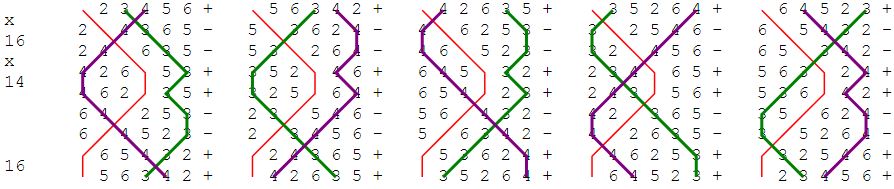
3-4

Crayford Little Bob Minor, 3-4

Crayford Little Bob on 3-4

Diagram: Crayford Little Bob Minor, 3-4.


5-6

Crayford Little Bob Minor, 5-6

Crayford Little Bob on 5-6

Diagram: Crayford Little Bob Minor, 5-6.


Artefacts
Place Notation
Grid

Artefacts

The only blue line feature worth noting is the (mandatory) dodge in 5-6 when treble makes 4ths.

Place Notation and Grid

Place Notation is not relevant to learning very simply structured plain methods. The grid is not relevant to learning very simply structured plain methods.

Pictels

Pictels are not relevant to learning very simply structured plain methods.


Ringing

Ringing Crayford Little Bob Minor.

Track the treble

Awareness of the position of the treble is a key skill for most bellringing methods, and a significant help in ringing Crayford Little Bob Minor. Some hints and tips for developing the skill are given in the techniques section.

Positional Awareness

The 4ths place half lead with the consequential dodge in 5-6 forces a handbell ringer to be more aware of 5ths and 6ths than when ringing plain bob.

In Plain Bob the hunting pattern for a pair of bells changes whenever one of the pair makes seconds at a Lead End and the other bell dodges. In Crayford Little Bob changes in hunting pattern also occur at the Half Lead when one bell is below the treble and one bell is above the treble. Mastery of this aspect of Crayford Little Bob is essential learning which is re-used when tackling more highly structured methods.

Place Notation Elements

The method only contains 4 elements (X, 12, 16, 14), all of which will already have been rung.

Place Bells, Pivot Leads, and Handrails

Pivot Leads

Pivot bell is the 4.
1-2 pivot when 2 leads at the half lead.
3-4 pivot when they cross in 2-3.
5-6 pivot when they dodge together in 5-6 behind treble in 4ths place.

Double Place Bells for Lead End 156342

156342 LE 16: Double Court Bob; Sandal Treble Bob, Hull Surprise

1-2:1-2, 1-6, 1-3, 1-4, 1-5, 1-2
3-4:3-4, 4-5, 5-2, 2-6, 6-3, 3-4
5-6:6-5, 3-2, 4-6, 5-3, 2-4, 6-5

Handrails

There is little chance to relax in Crayford Little Bob Minor.

Awareness of other bells

The busy nature of Crayford Little Bob gives little time for the novice to think about other bells.

Coursing Order in Little Bob Minor

Like Plain Bob, Little Bob is pure natural coursing order.

Conductors often use the "running out bell" as a confiirmation of making a call. This still applies in Little Bob, but you have only a couple of rows in which to spot the bell coming down in front of the treble. Try it, it's valuable training.

If the coursing order is a b c d e, when a is 2nds place bell, the bells lead (under the treble) in the order a, b, c.
b is pivot bell (leads at Half Lead), and c is followed by d becoming 2nds place bell. Bells d and e dodge together in 5-6 as the treble makes 4ths, and hunt down d before e.

Following the coursing order in this manner is a good discipline for the conductor, and is valuable preparation for ringing the many Minor methods that have Crayford Little Bob Lead End sequence..

Ringing the Method

Crayford Little Bob Minor gives valuable practice at watching the treble, and leads to an enhanced awareness of combined hunting 1-2-3-4 and dodging in 5-6.


Calls

Bobs and Singles.

Bobs and Singles in Crayford Little Bob are identical to Bobs and Singles in Reverse Bob. Bob is 1-4 in place of 1-6, and Single is 1-4-5-6 in place of 1-6


Touches

Touches of Crayford Little Bob Minor

Touches of Crayford Little Bob are also rung in a similar manner to Plain Bob, but the extent on 6 (720 changes) cannot be rung in Little Bob as the method does not include any rows where the treble is in 5ths or 6th place. Crayford Little Bob can be rung as part of an extent but only be “splicing” it in with a method where the treble plain hunts between 1st and 4th places and then dodges both ways in 5-6. Such methods are not included in this site.

4ths place bell is the pivot bell, and hence the first lead end is 156342 giving calling positions from the tenor as:
Before, Home, 4ths, In, Wrong.

Pivot bell - 4, and 1-6 at the Lead End produces 156342, classified as Group h by CCCBR. Touches for handbells can be found at: Group h compositions.